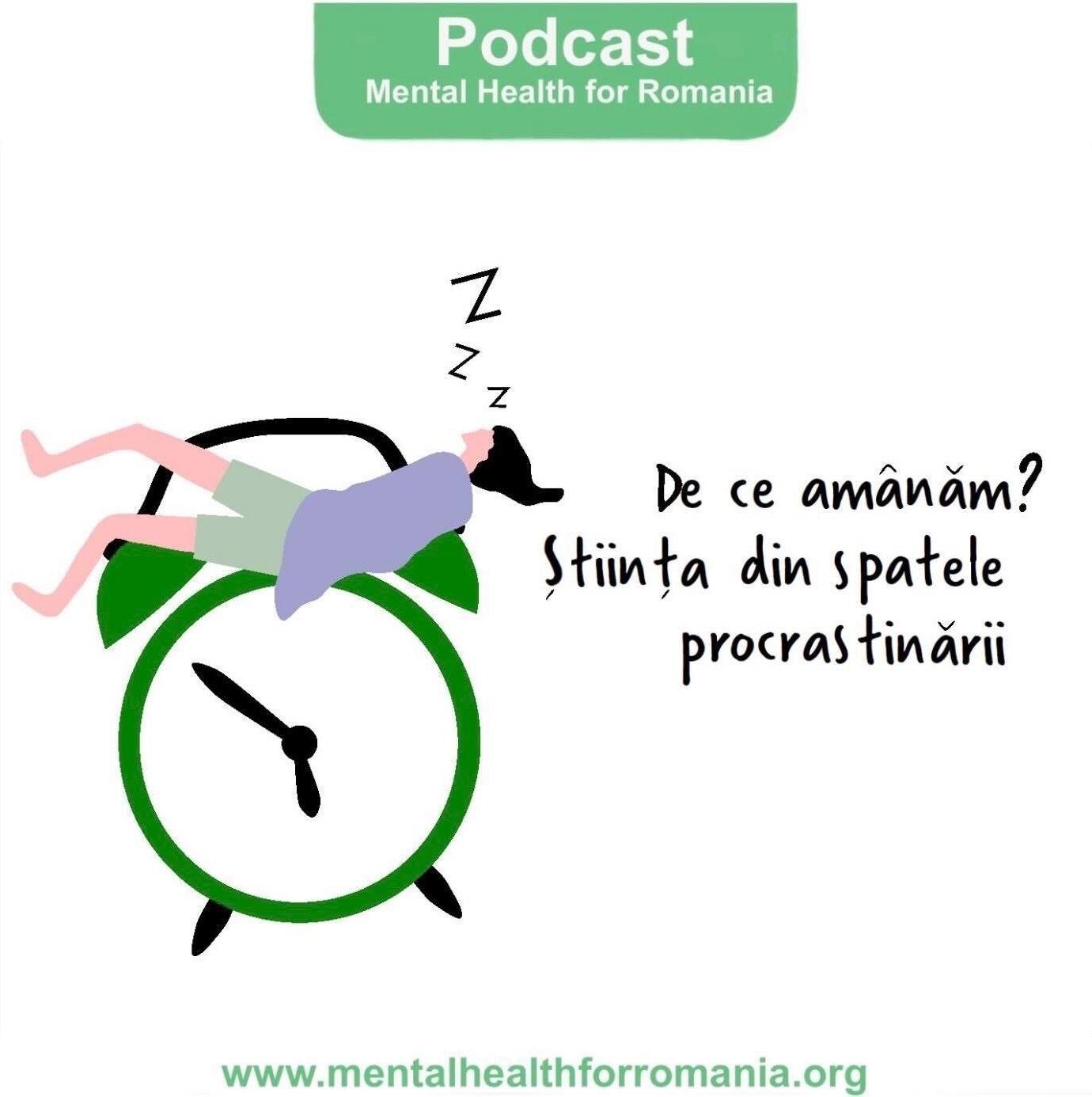
“Don’t put off until tomorrow what you can do just as well the day after tomorrow” – said Mark Twain. He was not the only one, however, because it is estimated that “procrastinastus”, a word of Latin origin meaning “to put off until tomorrow”, has been in use since the 1500s. If you want to learn more about why we procrastinate, the research behind this phenomenon, and how to take action, we invite you to listen to the full episode.
11 April 2023
self-care ● stress ● burnout ● learning difficulties
Why do we procrastinate? The science behind procrastination
Listen to the episode on:
Transcript (translated)
Hello and welcome to a new episode of the Mental Health for Romania podcast! I’m Larisa, and I’m a PhD candidate in cognitive neuroscience in London. In this episode, I’d like to explore the science behind delay and procrastination. I don’t think there’s anyone to whom the feeling of putting things off, delaying, or procrastinating is unfamiliar. Thinking of a personal example, I can honestly say that I spent a long time thinking about the concept for this episode—what I was going to talk about, which studies I was going to read in preparation—before I actually started typing words into a blank document. I made a plan and told myself I would carry it out, yet I kept postponing the very actions that would eventually bring that plan to fruition.
Perhaps you’ve experienced something similar. It’s the week before an important exam. You know you ought to start going through the material as soon as possible, but you keep putting it off. You look around, perhaps. “I really should tidy up before I start. I can’t study with this mess all around me.” “Right, that’s better now, but I’m feeling a bit hungry. I don’t really fancy anything that’s in the fridge, so why don’t I pop to the shop, buy a few ingredients, and cook something a bit more interesting for a change?” “I’ve been telling my friend for ages that I’d give her a ring. I’ll call her now, and afterwards I’ll be able to concentrate on studying much better.” “Well, I’m really glad we had that chat, but would you look at that—it’s already eight o’clock in the evening, and it feels a bit late to start now. I mean, who can really concentrate at this hour anyway? I’ll start tomorrow.” And so it goes on. Does that process sound familiar?
Well, it’s believed that the word “procrastinate” comes from the Latin “procrastinatus”, the past participle of the verb “procrastinare”, meaning something along the lines of “to put off until tomorrow”. The Latin word has been in use since the 1580s, while a similar French verb, procrastiner, dates back even earlier, to the 1540s, with the meaning “to delay”. In other words, the experience of procrastination is not a modern concept, and the origin of the word suggests that people have been grappling with this challenge since ancient times. In fact, there are countless quotations that point to this idea, some of which you may well have heard. Mark Twain famously said, “Never put off till tomorrow what may be done the day after tomorrow just as well.” The Stoic philosopher Seneca wrote, “It is not because things are difficult that we do not dare; it is because we do not dare that they are difficult.” And in Ecclesiastes we find the verse, “Whoever watches the wind will not plant; whoever looks at the clouds will not reap.” So, as you can see, people have been referring to the phenomenon of procrastination since the earliest times.
Up to this point, you might be thinking that what people say about those who procrastinate is actually true: they’re lazy, they put things off, they leave until tomorrow what they could do today, they’re incompetent. Well, you can breathe a sigh of relief—procrastination can be explained by both biological and psychological processes. Because it’s such a widespread issue, many researchers have focused on understanding it better and have proposed a number of theories. One of these suggests that people who procrastinate use cognitive avoidance strategies to regulate their immediate emotions, despite their long-term goals. In other words, it’s all about self-control. Should I, so to speak, sacrifice my current comfort and peace of mind in order to achieve a goal in the future? Hmm… I’m not so sure about that.
The way we regulate these emotional states is largely governed by two interacting systems—a cognitive system and an affective system. The cognitive system is located in the prefrontal cortex, which is responsible for goal-directed behaviour, decision-making and, more generally, the functions that make us who we are. The affective system, on the other hand, is governed by the limbic system, which is situated in a much older part of the brain and is responsible for many automatic processes, such as fleeing from danger. As I mentioned, these two systems do not operate in isolation; they interact with one another. When procrastination wins out over taking action, it means we’ve made a decision based on what makes us feel good right now, rather than what will benefit us at some point in the future. In other words, procrastination is a battle between our present self and our future self.
And, of course, there are people who are convinced they produce their best work under pressure. It’s true that you can sometimes achieve a good result even when you leave things until the very last minute, but we have to ask ourselves: at what cost? Sleepless nights, high levels of stress, feelings of guilt for having procrastinated, and the inability to truly relax because, although we’ve postponed the task itself, it’s never really left our minds. We keep thinking about it, and that drains a great deal of our mental energy—it eats away at us, as the saying goes. If you achieve a good result after pulling an all-nighter, you’re more likely to rely on that strategy again in the future, and that has to do with the way our brains process rewards. The feeling of success is fresh in our minds, making us forget the stress we went through to get there. “It was all worth it,” we tell ourselves. “It wasn’t that bad. Maybe I’ll do the same next time.” Well, both I and many other scientists who have studied this phenomenon would suggest that you don’t. It’s wonderful if you’ve managed to achieve a good outcome despite the difficult circumstances—in this case, procrastination—but it’s worth considering how it might have felt to achieve the same result, or perhaps an even better one, without all the stress beforehand. What’s more, overcoming procrastination means learning to regulate your emotions more effectively. Remember the limbic system I mentioned earlier, because procrastination isn’t a problem of time management—it’s a problem of emotion regulation. People who procrastinate know perfectly well that they have a deadline in two days’ time; that’s not the issue. They also know what time it is. The issue is that they make suboptimal decisions.
But after all this theory, the good news is that there are things we can do to better manage those situations in which we’re tempted to choose what’s comfortable in the moment over what’s better for us in the long term. These include:
- Reward yourself for the work you’ve done. Tell yourself that once you’ve completed a task on your to-do list, you’ll do something you enjoy—not the other way around. One important point, though: when we procrastinate, we choose the immediate reward at the expense of the reward that comes later.
- Work in public or alongside someone else. It’s easier to stay focused when you feel a little positive external pressure and when you’re in an environment where you can see positive examples of people working towards their goals.
- Break large tasks down into smaller, more manageable ones. When what you need to do is more clearly defined, tasks no longer seem quite so intimidating. By the end, you’ll have the personal satisfaction of knowing you’ve made progress, and you can give yourself a well-deserved pat on the back—it feels great. Give it a try!
- Get enough rest and take regular breaks. Sometimes we put off getting started because we’re tired, we feel we don’t have the mental resources to concentrate, and we know we won’t be very productive. In the fifteen minutes between classes, meetings, or whatever else you have planned, try closing your eyes for a moment or going for a short walk to get some fresh air, instead of scrolling on your phone and staying stuck in that same state of fatigue and stress.
- Next, get your body moving. You don’t have to run 5 kilometres, but research has shown that physical activity helps us feel more motivated and improves our overall sense of wellbeing. It might seem as though you’re procrastinating, but you’re not. Very often, the best thing we can do to improve our focus is to pause for a moment and take care of our basic needs: moving our bodies, getting enough rest, and eating properly.
- Finally, change the way you think about failure. Self-criticism isn’t nearly as motivating as we might believe. Self-compassion, on the other hand—even after a setback—is associated with greater motivation and better outcomes. Give it a try the next time things don’t turn out as you’d hoped.
- And finally, in the book “Why Has Nobody Told Me This Before?”, Julie Smith, a clinical psychologist in the UK, explains that if we create a clear picture of our future selves, it becomes easier to make decisions in the present that will benefit us in the long run. She argues that, just as it is helpful to imagine the future we want, it is equally valuable to think about the future we don’t want. She suggests completing a simple pros and cons table, comparing the option of leaving things as they are with the option of working towards change. This exercise is based on the principles of Dialectical Behaviour Therapy (DBT), which helps people develop healthier ways of managing their emotions. It’s a useful exercise whenever you have something to do but don’t feel motivated. What are the advantages of leaving things exactly as they are? What are the disadvantages? And what would be the benefits and drawbacks of making a change? Think about those questions the next time you’re struggling to find the motivation to get started.
And to finish, I’d like you to remember that a certain amount of procrastination is perfectly normal and is closely linked to the way our brains work. It’s simply easier for us to choose an immediate reward, even though doing so may put us at a disadvantage in the future. However, if you struggle with chronic procrastination, you may benefit from therapy, which can help you address the underlying issues behind this behaviour. For example, it can help you better understand your emotions and learn healthier ways of managing them, rather than relying on avoidance and delay. If you’re looking for a mental health professional who meets your needs, we invite you to explore the Mental Health for Romania Map of Professionals, which you can find on our website.
In this episode, we’ve learnt more about why we procrastinate, the research behind this phenomenon, and how we can take action instead. If you’ve stayed with me until the end, thank you so much for listening, and I’ll see you in the next episode. Until then, take care of yourself and your mental health. Bye!
