
This article addresses the link between art (mainly fine arts), artists and mental health. Both art therapy and what patients in psychiatric hospitals have been able to create and how they have contributed to a new movement are discussed.
Francisco Goya, Paul Cezanne, Vincent van Gogh, Edvard Munch, Mark Rothko, Jackson Pollock. They all suffered from mental disorders. That hasn’t stopped them from creating works recognisable decades later. They have made a name for themselves both during their lifetime and long after, overcoming the limits imposed by their specific mental suffering. Art for them was their escape from the harrowing reality.
Francisco Goya
In 1792, Goya was incredibly unwell, with constant fever and constant confusion (he was said to be suffering from encephalitis). Even when he recovered physically, he still suffered from episodes of hallucinations, depressive states and emotional outbursts. After his struggles, he decided to transform mental illness and those suffering from it into a series of engravings entitled “Los disparates” and “Los proverbios”, from 1815 to 1824. He never exhibited them, nor were they revealed to the public until 40 years after his death.

“Los disparates” – Francisco Goya & “Los proverbios” – Francisco Goya
Paul Cezanne
Paul Cezanne had repeated bouts of depression and expressed them in a multitude of canvases such as “Pyramid of Skulls”, “Murder”, “Young Man with a Skull” and three works entitled “Self-portrait”.

“Young Man with a Skull” – Paul Cezanne & “Self-portrait” – Paul Cezanne & “Pyramid of Skulls” – Paul Cezanne
Vincent Van Gogh
Van Gogh also had depressive episodes, frenzies and repeated hallucinations. Doctors blamed absinthe for the artist’s poor mental state, but he was diagnosed post-mortem with a variety of illnesses, including bipolar disorder. The mood swings, obsession with death and psychotic perceptions can be seen in many of his works, the best known being “Starry Night”, “Portrait of Dr. Gachet”, “Self-Portrait”, and “Vincent’s studio window at St. Paul’s Hospital in Saint Remy”.
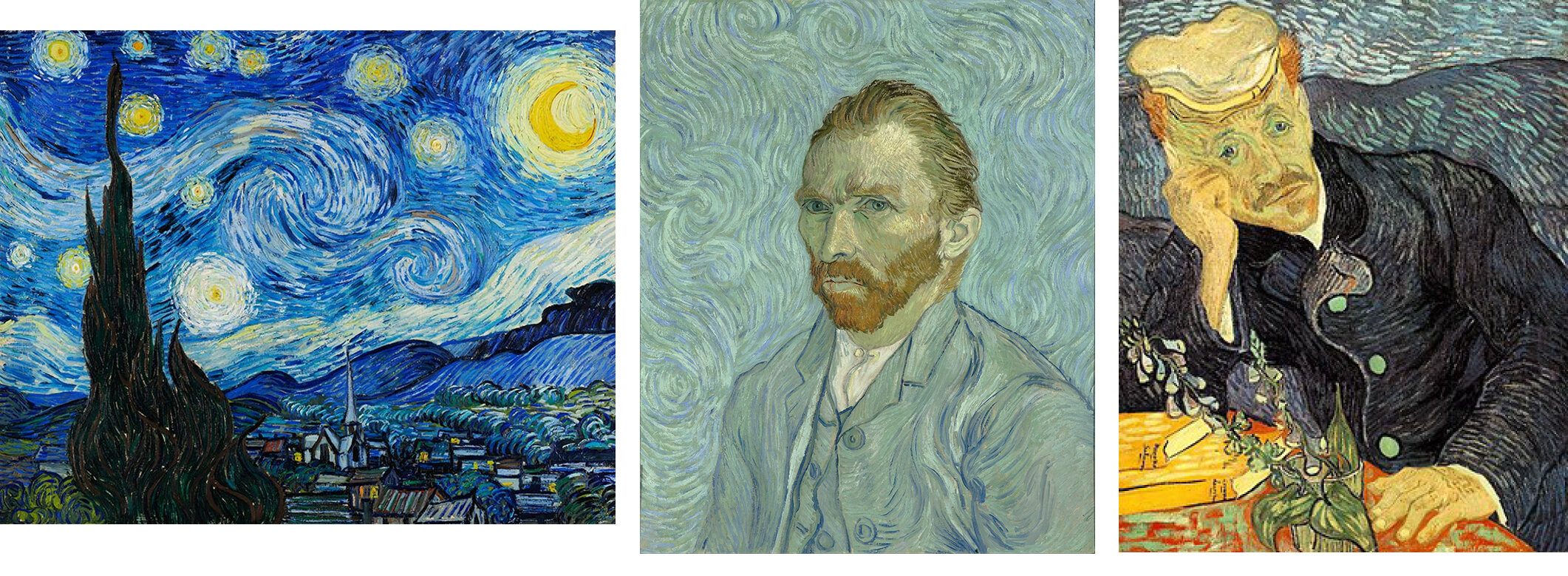
“Starry Night” – Van Gogh & “Self-portrait” – Van Gogh & “Portrait of Dr. Gachet” – Van Gogh
Edvard Munch
Most Post-Impressionists are known for exposing their conditions in art. Despair and helplessness are best shown in the well-known work “The Scream”, by the Norwegian Edvard Munch, for which there are several versions. Most of his paintings expose his fears and convey despair, helplessness, and his lack of faith in a better life. These include “Anxiety”, “Vampire” and “Melancholy”.
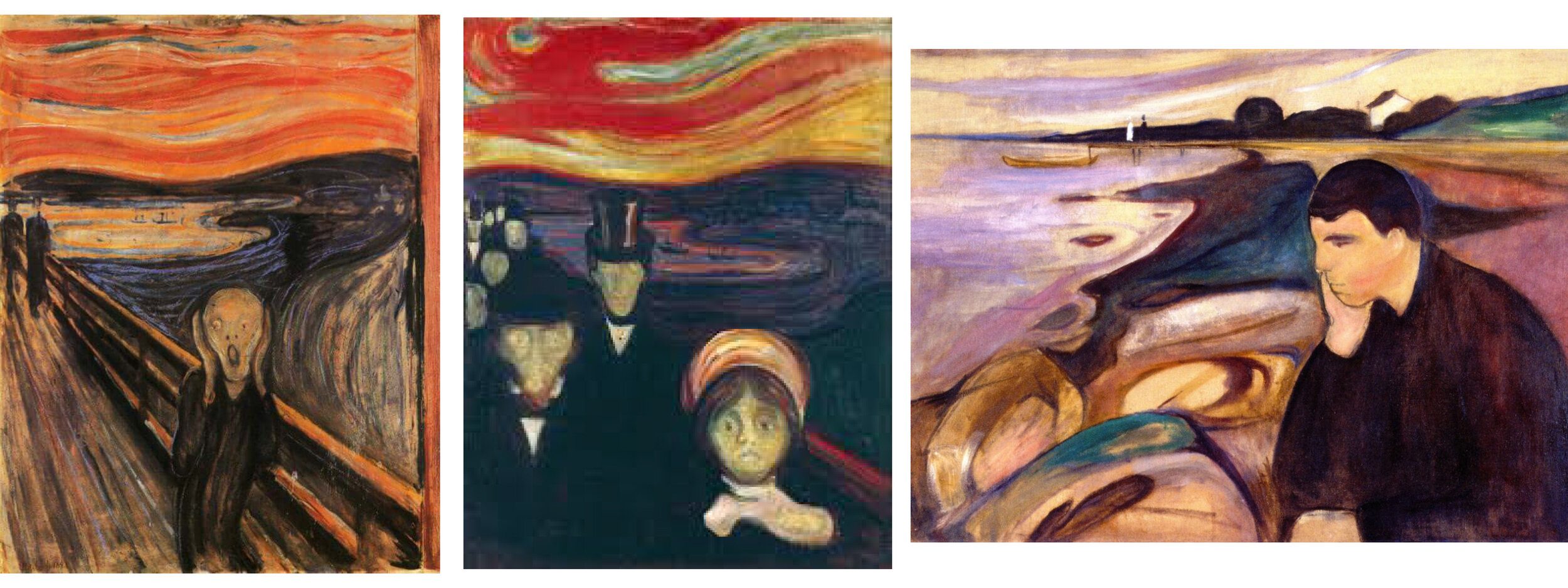
“The Scream” – Edvard Munch & “Anxiety” – Edvard Munch & “Melancholy” – Edvard Munch
Mark Rothko
Rothko struggled with depression all his life. The deep colours in his paintings provoked feelings of sadness in both viewers and himself. Most of these are untitled.
Jackson Pollock
Jackson Pollock was dependent on alcohol and, unable to stay sober for long, he exposed his suffering, sadness and suicidal ideation through art. There is a recording of him expressing his internal chaos on canvas, an activity that brought him spiritual fulfilment and a certain peace.

“Untitled” – Mark Rothko & “Convergence” – Jackson Pollock
The question remains. Is there clearly a link between creativity (art) and mental illness? There are a multitude of studies on this aspect. The oldest say yes, but the most recent, such as the one led by Simon Kyaga from the Karolinska Institute in Stockholm or the one led by the University of Gothenburg, argue exactly the opposite. Although on a large scale there is a certain link between the two, one does not always imply the other, with researchers finding no clear association between being creative and having a psychiatric condition. We are still left with questions such as “If you are a writer, for example, will you develop a psychiatric problem?” or “Do mental health problems lead to individuals trying to express their inner feelings in a creative manner?”.
On the other hand, art helps people express their emotions, to give them a form regardless of their nature, so we can use this mode of expression as therapy. As Emil Cioran argued, art can help both the artist and the viewer/reader. The philosopher said in “Anathemas and Admirations” that constant writing helped him during his long periods of insomnia, even believing that it stopped him from committing suicide. Writing was the ultimate form of therapy for him.
Similarly, Frida Kahlo said that art, painting more specifically, was there for her when no one else was. Physical pain and health problems became part of her daily life after a serious bus accident. Her artistic work shows the trauma she went through, the immobility and the psychological and physical pain she was constantly exposed to.
There are many examples of artists for whom their own art was a form of therapy. So, is art a form of therapy in general? Definitely yes. The first documentation of art therapy appears in the mid-19th century in Scotland, where patients in asylums were encouraged to draw and paint. Since then, art therapy has evolved to become a discipline in its own right, offering studies, Master’s programmes and even doctorates.
It is used for hospitalised patients with severe and persistent mental problems, but also for patients with depression, different types of anxiety and emotional problems. There are many rehabilitation programmes, as well as programmes for those diagnosed with an autism spectrum disorder that use art therapy. Also, this type of therapy is used for people without mental health problems as a way to express their feelings and thoughts.
Regarding the artists presented at the beginning, we cannot say clearly what stage they were in from a mental point of view, as there are no concrete documents to attest to this. We will also mention people whose disorders were diagnosed and whose art was created during their stay in psychiatric hospitals.
A year after psychiatrist Walter Morgenthaler published a monograph on the life and art of Adolf Wölfli (a schizophrenic patient he was caring for), Hans Prinzhorn published “Artistry of the Mentally Ill”, a text about mental illness and creativity. Prinzhorn’s studies received a lot of public attention and even interest from artists such as Paul Klee, Max Ernst and Jean Dubuffet. In 1940, the term “art brut” appeared, as well as the concept of “Outsider Art”.

Author of the work: Adolf Wölfli
It is believed that the most interesting works of art created in psychiatric hospitals are those of schizophrenics. Even a well-known artist by the name of Louis Wain was among them. At the beginning of his artistic life, he painted anthropomorphised cats with large eyes that often played games of chance. Shortly after his wife died, his depression was triggered and he was also diagnosed with schizophrenia at age 57. He began to become aggressive and was hospitalised, spending the last 15 years of his life institutionalised. Not only was his personality affected, but also his artistic style, with his paintings resembling his initial art less and less (for example, his famous smiling cats became more geometric and colourful). Most of these psychedelic cats were born at Napsbury Hospital, where Wain was hospitalised and died.

Shortears Began And Sung A Solo (1886) & Cat Drawing (c. 1920s)
Schizophrenics give a specific, indeed remarkable, form to the things they see. Most include eyes and various machines designed to spy on them and collect data about them, as most suffer from paranoid schizophrenia. The torment they go through makes them very precise when describing their beliefs. On the other hand, the eyes can represent how self-aware they are as well as their connection to the real world.
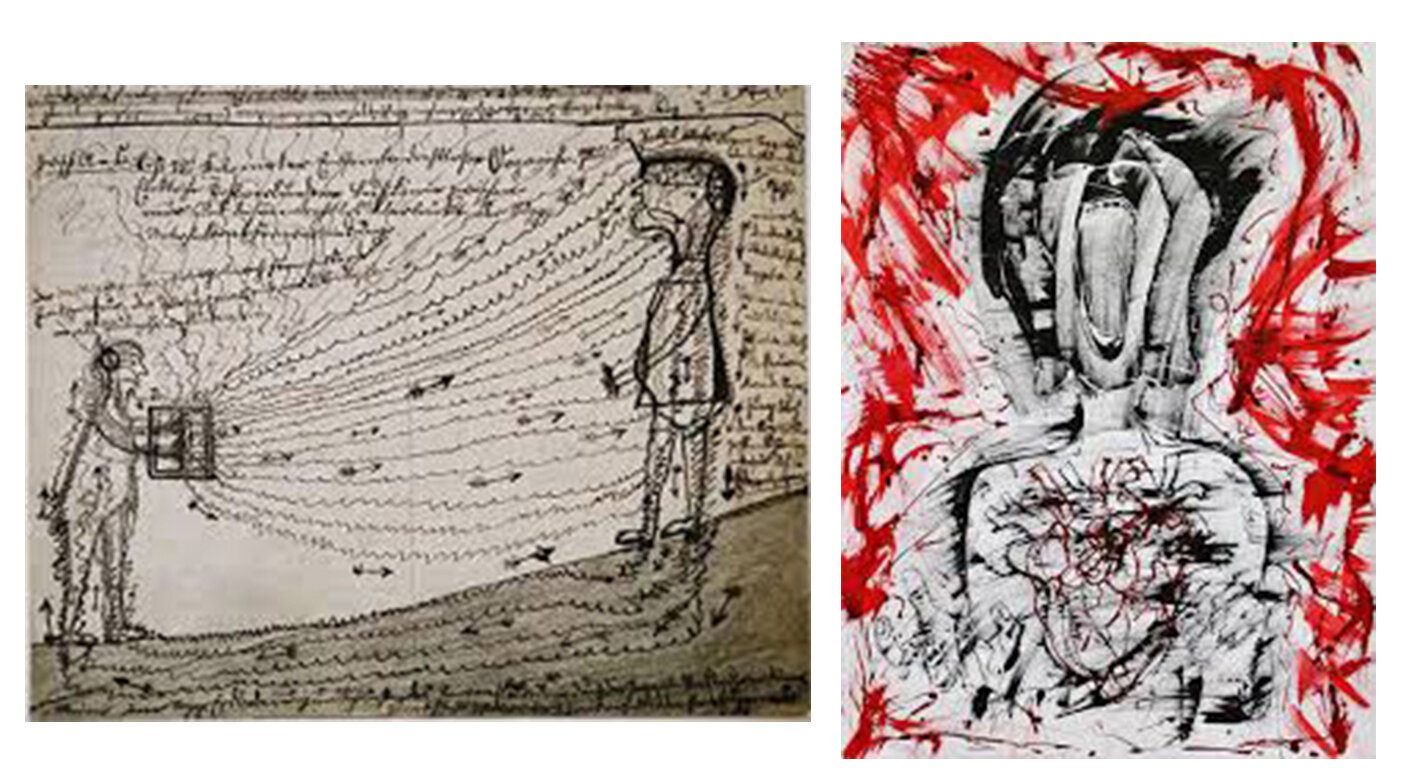
Untitled

“Self-portrait” – Bryan Charnley
Most of those who suffer from schizophrenia want to refrain from medication because they claim it takes away their inspiration, one concrete example being the mathematician John Nash.
The art of those in psychiatric hospitals has also inspired numerous artists who do not suffer from a mental illness to create canvases showing different conditions such as: social anxiety, depression, insomnia, post-traumatic stress disorder, bipolarity, borderline personality, autism spectrum disorders, obsessive-compulsive disorder and anorexia.
We thus see how art often has the power to vividly express feelings and states that otherwise remain hidden deep down and mix among thoughts.


https://highexistence.com/18-mental-illness-drawings/
Resources:
[1] The link between creativity and mental illness, confirmed by the largest study ever conducted
[2] The link between creativity and health
[3] The Problem With Studies Claiming Artists Have Higher Rates of Mental Illness


