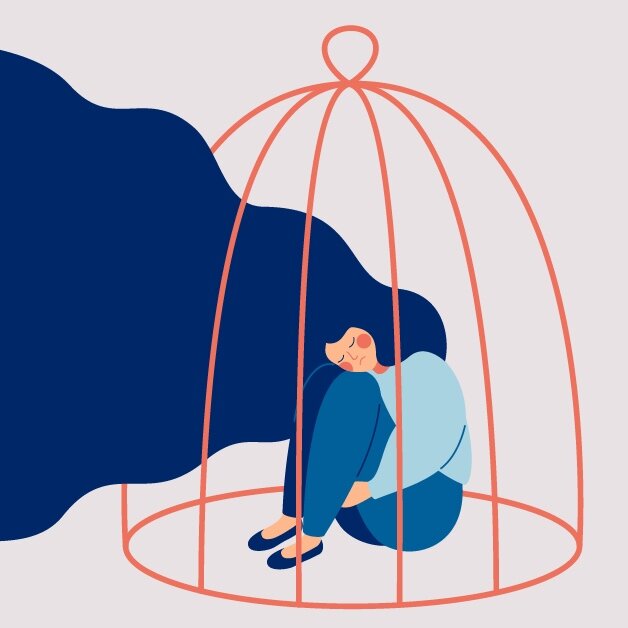
Most cases of domestic violence, be it physical or psychological, are due to the perpetrator being confronted with violence since childhood, implicitly learning that violence is the way to deal with conflict. Contextual factors such as anger, stress and excessive alcohol consumption also facilitate violent behaviour.
It is important to note that emotional (psychological) abuse is just as harmful as physical abuse. Because it doesn’t leave visible signs to the naked eye, it often goes unnoticed, or in many cases, is not treated as seriously as forms of physical or sexual violence.
According to an analysis conducted by INSP in 2015, victims of domestic violence are prone to a series of transient or permanent disorders; for example: depression, anxiety, various phobias, panic attacks, post-traumatic stress disorder. If affected people are exposed to long-term abusive and stressful situations, they may be vulnerable to personality disorders. The behaviours and coping mechanisms they resort to, largely due to a lack of support, often involve the use of alcohol or other substances.
Therefore, preventing cases of domestic violence and supporting survivors, especially during social isolation, means preventing an increase in associated mental health disorders.
I wondered how an association that works in the social system to protect abused women operates. In Brasov, abused mothers or young women from foster care centres who come out of a system that deprived them of the things that most of us take for granted, can receive guidance from an association that works on all levels of development to reintegrate them socio-professionally. I spoke to Mariana Busuioc (head of services at the SCUT Association), who told me how her team deals with these cases.
“Our association has two components: the day centre for adults with chronic mental health conditions (they come here for 2-3 hours for socialisation, recreation and group therapy) and the vulnerable youth and families component. Young people leaving foster care come to us and ask for support because they don’t have a home or a job. We work with a young person for about 2-3 years until they manage to stabilise emotionally and integrate socio-professionally. The mothers at social risk are, in fact, young women from foster care who have since become single because they went through the trauma of abandonment and their partners have either left them or are in prison, and they found themselves alone with one, two, three or four children. There are many prejudices: ‘why should I help her?’, ‘who told her to have so many children?’, ‘did I make the child sick?’ or other similar remarks. Personally, this aspect affected me a lot. You never know how life hits you and you could have mental or emotional problems too, or a disability, or a sick child… When you have support, you get through troubles more easily. In the end, I think that is our essence. If you allow yourself, empathy can be learned.”
The women we work with were not prepared for the role of mother. They barely know how to take care of themselves in daily life, let alone look after two or three children. We try to support them to hold on, to survive, to get out of the crisis situation and to move forward.
In general, people who leave foster care are not to blame for their parents abandoning them and for going through all kinds of trauma throughout their childhood and adolescence. They didn’t have parental role models, they didn’t have the affection they needed (at least in the first five years of life when the most important developments occur). And so you can’t say about a young person, ‘they have two hands and two feet, why don’t they go to work’. There are many mechanisms that don’t let them do these things. They are moved between 4-5 centres until they leave the system. They have faced instability all their lives, so it’s normal for them to think, ‘I’m not going to a job just to stay 2-3 months and leave’, or ‘I won’t make friends because they break and it hurts’.”
How do these people find you?
“Most of the time they come because someone told them we offer services, they are brought by another beneficiary, or they are sent by the Child Protection Directorate or the Social Assistance Directorate. At the latter, mothers cannot receive concrete life skills services or counselling; they can only receive either the guaranteed minimum income allowance or the single-parent allowance.”

© CreativeMarket.com
How does a first case assessment session take place?
“The beneficiary comes with her children or alone, and we do an initial assessment to see if she fits into our social programmes. If she is not eligible, we redirect her to other services in the community. We offer 1-2 counselling sessions so she can reach other services – such as the Bucuria Darului Canteen (for those who have nothing to eat) or the ‘Aici pentru Tine’ Association. If she fits into our programmes, we start a more detailed assessment: we create a file, a social services contract and everything related to the legislative side and quality standards for social services. Then, we start working, set up meetings, and take it step by step.”
“First, we establish a trusting therapeutic relationship with the social worker, so they can express as many of their needs and problems as possible. Then we work on the social side: we mediate collaborations with different institutions to obtain social rights or access to education. There were mothers, for example, whom we helped to access a place in a nursery or school. It’s very hard, especially if every time you go to enrol your child you’re told there are no more places. Then we have to provide everything from basic needs (essentials for the nursery: nappies, wipes, changes of clothes, footwear, transport, food, clothing and hygiene items) to counselling and group therapy, socialisation projects, recreation and education.”
What is the final goal after these three years of work?
“The goal is for the beneficiaries to no longer depend on us or other social services. For the most part, we succeed within this timeframe (although there are people who, no matter how much you work with them, do not want to change the situation they are in).”
“In their view, the goal is for their own life story not to be repeated for their children – to be abandoned and go through what they went through. And so, they fight tooth and nail to continue in the initial situation, which often doesn’t work out for them because they can’t cope due to a lack of skills and necessary resources. Then they say to themselves, ‘Rather than the child suffering with me, I’d better put them in foster care because there they have a home, food, everything they need… At least until I get back on my feet’. However, this ‘getting back on one’s feet’ takes longer than expected, or never materialises, and the child remains in state care. What we try to do through these programmes is to prevent abandonment.”

© Dreamstime Stock Photos
Through what activities do you manage to empower a young woman who leaves a system where she doesn’t gain basic life skills, and how does she become an autonomous adult?
“Through a fairly complex programme, in my opinion, because we work on all levels: emotional, psychological for abandonment trauma, social, professional, educational and independent life skills. There are projects to strengthen our relationship with them because they become more trusting of us, the social workers, and this accelerates positive results. In this way, they realise that life can be beautiful and normal, and thus gain confidence that it is possible.”
“Specifically, we offer group and individual counselling and social assistance counselling. This year we have a project written specifically for mothers, which ensures access to education (mothers will do training and parenting courses), we pay for the children’s nursery and preschool, we provide medical services (gynaecology, dentistry), we have a personal development group, and a socialisation and recreation group for beneficiaries (we take the children to a playground while we go out for tea with the mothers). In this way, a bond is created between the social worker and the beneficiary, and they learn in a different context (more relaxed and unforced).”
“We also work on pregnancy prevention with young women in foster care – we collaborate with the ‘Agapedia’ Association, which has a family planning centre and provides counselling and gynaecological consultations. Communication between institutions is very important because that’s how resources are used optimally.”
“Last year we organised a trip to Moeciu de Sus where the mothers went to Bran Castle (while volunteers looked after the children), we took them for manicures, to the hairdresser and for massages. We did things for them to feel complete because they are not just mothers, they are also women. They tend to neglect themselves, so it’s important they learn to respect themselves and that we increase their self-esteem – to provide care for their children, they first and foremost need to take care of themselves.”
Can you give me an example of a case dear to you where the beneficiary was completely reintegrated socio-professionally?
“A case very dear to me is that of a young woman who came to us very timidly when her child was just over a month old. She had left the protection system at eighteen, had a relationship, got pregnant, and they lived at her partner’s mother’s house in a tiny room. There were constant arguments and rows, and she left him. We worked on the relationship side because she was going to work and he wasn’t; at one point, police intervention was even needed because he was waiting for her at the gate… I worked with her for about three years and now she has her own home, she’s employed, she has a stable life partner she wants to marry this year, the child is at nursery, she’s pregnant again, but this time she’s in a stable, supportive relationship, without violence.”

© iStock.com
As a social worker, what is it like to work with such an emotional burden every day?
“Not just as a social worker, but also as a psychologist, it’s quite overwhelming, because it’s not just one or two cases, there are many, with a multitude of needs and many traumas and problems. We have peer supervision among us social workers, we find solutions together and ‘vent’ about what’s happening. You can also see that not many people last in the system (there’s even a crisis in the labour market from this point of view).”
Regarding the way of working in social assistance, what is the balance between bureaucratic work and fieldwork?
“Before the legislation in the field changed, it was okay. The paperwork was as much as it needed to be – in the sense that you did a social inquiry, an assessment, a beneficiary profile, an intervention plan and monitoring. But now there’s more and more, and it becomes more demanding to do documents (and keep them up to date) than to work with the beneficiary. And somehow the work becomes more frustrating from this point of view because your time for direct work with that person is effectively taken away. The working hours are the same, it’s just that now you have to allocate more time to the files.”
“And it’s not just about social assistance procedures; for example, the amount of the allowance or the criteria for accessing a social right can change. We need to know all these things because you have to guide the beneficiaries on how to obtain certain documents, where they need to submit them, what’s needed for the file, and you have to be up to date with all the changes. The good part is that now you have the internet and can access information at any time, plus there is effective inter-institutional collaboration and that helps a lot.”
We are all the community.
Mariana told me that “lately I’ve seen things moving slowly but surely. I’ve noticed that in Brasov, the volunteering and support component is starting to be seen differently”. Thanks to the extraordinary mobilisation of dedicated people, but also through gradual changes in the general mentality, a difficult socio-economic and personal context no longer necessarily represents an insurmountable obstacle – with the right help and enough motivation to get out of an unfavourable situation, there is a chance for reintegration and regaining independence.
If you are facing acts of domestic violence or encountering difficulties in communicating with family members during this difficult period (or in general), going to a psychologist can contribute to resolving and preventing critical situations. It is never a shame to admit the existence of behavioural problems (your own or those of people close to you) and to ask for help from a specialist!
Useful phone numbers and information campaigns to combat domestic violence during isolation:
0800 550 333 HELPLINE with a unique free national number for victims of domestic violence, established by the National Agency for Equal Opportunities between Women and Men (ANES)
ANAIS Association: 0736 380 879, https://www.izoleazaviolenta.ro/
Solwodi Association: 0756 514 940, http://solwodi.ro
Necuvinte Association: 021 243 33 33, http://www.necuvinte.ro
Casa Ioana Association: 021 332 63 90, https://casaioana.org
Casa Blu Counselling Centre: 021 311 46 36, http://www.fundatiasensiblu.ro/programe/program-casa-blu/programul-casa-blu/
Websites of the General Directorates for Social Assistance and Child Protection (DGASPC) for information regarding the existence of emergency shelters or temporary social housing for victims of domestic violence at the county level: http://anpd.gov.ro/…/directiile-generale-de-asistenta-soci…/
112 UNIQUE EMERGENCY NUMBER available free of charge nationwide
Information sources:
APFR – Causes of domestic violence
Romanian Police – Causes of domestic violence
National Centre for Health Evaluation and Promotion – Causes of domestic violence
World Health Organization – Intimate partner violence and alcohol


