
Contents:
- What are eating disorders?
- Prevalence
- Causes & risk factors
- Main types
- Symptoms: how to tell if I might have an eating disorder
- How are eating disorders treated?
- What should I do if I have symptoms?
- Guide for loved ones: what should I do if I notice signs in a loved one?
What are eating disorders?
Eating disorders are medical conditions that manifest as an altered eating behaviour, such as overeating or undereating, usually accompanied by a negative self-image and obsessive thoughts about your body or weight.
NB: eating disorders are often extremely serious and can be life-threatening. They are NOT a personal lifestyle choice. Educating yourself on this topic can help you spot the signs of a potential eating disorder and seek help early. It will also help you better understand and support those who suffer from such a condition.

© squarespace
Prevalence
There are no statistics on eating disorders in Romania. Estimates based on studies in the UK and the USA show that in both countries, approximately 2% of the population, or 1 in 50 people, suffer from an eating disorder [1,2]. This percentage corresponds to approximately 400,000 Romanians (a similar estimate has also been made by APTTA [3]).
Causes & risk factors
It is not known exactly what causes eating disorders, but it is believed to be a combination of biological, psychological, and social factors. Some of the risk factors identified so far are family history, sexual abuse, bullying, lack of self-confidence & self-esteem, perfectionism, problems at school/work, criticism from others about weight, and external pressure to have a perfect body. Individuals who struggle with eating disorders often suffer from other mental health problems too, especially anxiety and depression.
It is important to realise that, despite stereotypes, anyone can develop an eating disorder, regardless of gender, age, or family background. Although statistics show that the group most at risk are young women, the prevalence in men and older people may actually be higher than estimated, due to their lower propensity to talk openly about their mental health.
Main types
- anorexia nervosa: when you have a very low weight and try to maintain it through starvation and/or intense exercise, you are extremely afraid of gaining weight and feel that you are never thin enough

© Ella Byworth
- bulimia nervosa: when you have a normal weight but go through cycles of excessive and uncontrolled eating, and then try to compensate by vomiting, taking laxatives and/or excessive physical exercise
- binge eating disorder: when you regularly go through short periods of excessive and uncontrolled eating (in English: “binge eating”), and then feel guilty and/or upset
- other specified feeding or eating disorder (OSFED), when you have “atypical” symptoms that do not clearly place you in any of the three categories above, but you are in an equally serious condition
Symptoms: how to tell if I might have an eating disorder?
- An eating disorder can manifest in many ways, depending on the person and the type of disorder (see above). However, the following symptoms are often encountered in one form or another:
- you spend a lot of time worrying about your weight and body shape, and/or have a distorted perception of your own body or a fixation on certain body parts

© Jessica Olah & Jessica Olah, Verywell
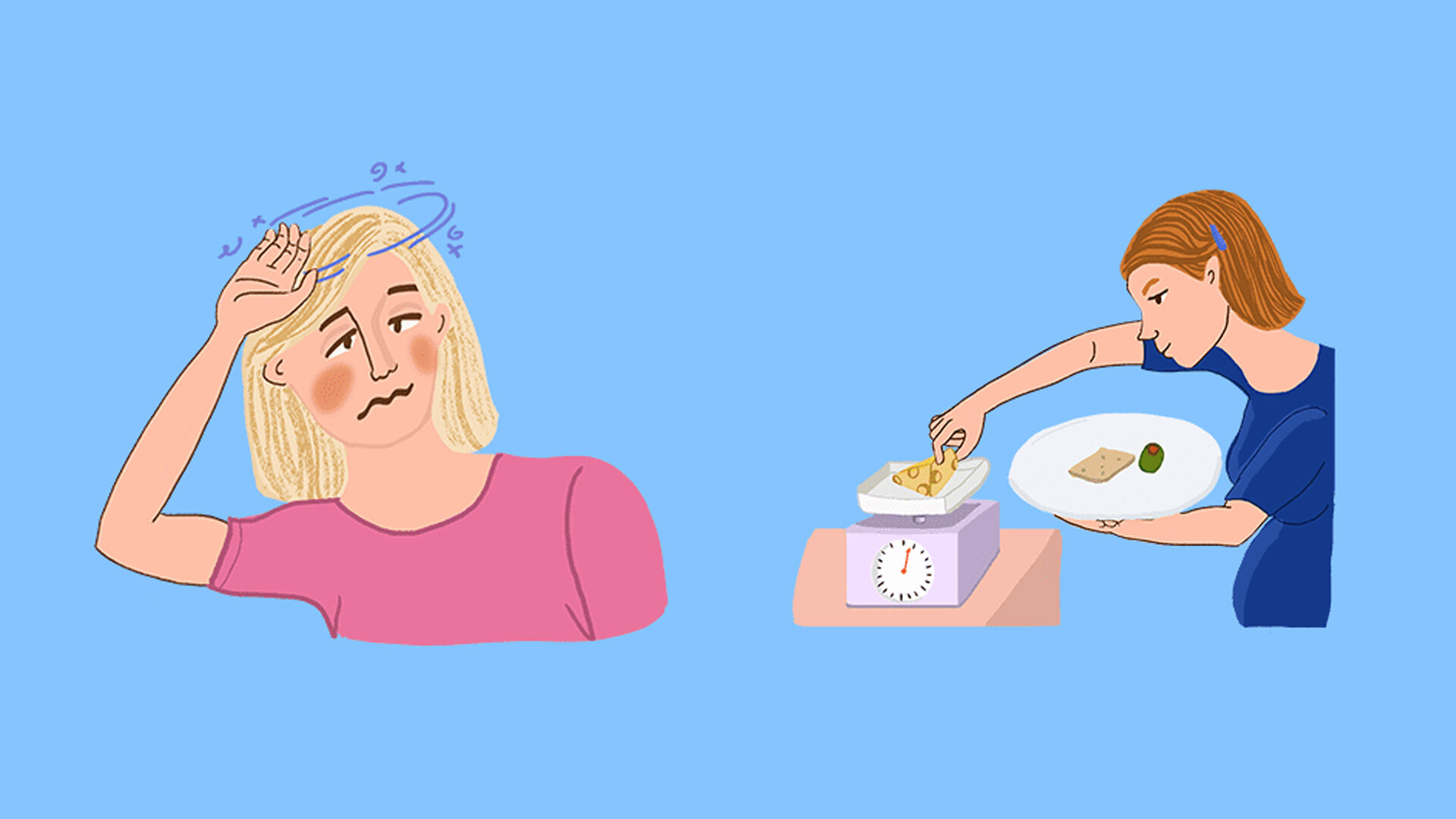
- you eat very little food or eat too much in a short period and in an uncontrolled way
- you feel the need to “compensate” for how much/what you have eaten, so you induce vomiting or take laxatives after eating or exercise excessively, to the point of exhaustion

© Jessica Olah & Jessica Olah, Verywell
- you have a very low or very high weight for someone of your age and stature, or you notice that your weight fluctuates often
- you have a changeable mood
- you withdraw from social contexts, especially where food is present
- you have very specific rituals related to eating, you feel a strong repulsion towards “forbidden” foods
- you feel guilty about hunger or what/how much you eat

© JR Bee, Verywell
- you weigh yourself very often or obsessively count calories
- you have digestive problems (constipation, stomach aches)
- you often feel tired, dizzy, or even faint
- for girls and women: you do not have periods
© Jessica Olah, Verywell
How are eating disorders treated?
Eating disorders are treatable. The primary goals of treatment are the normalisation of eating behaviour and attitude towards body weight, and addressing the medical and cognitive consequences of malnutrition. Patient management is ideally carried out through collaboration between several types of specialists: family doctor, nutritionist, psychiatrist, psychologist, and other specialities, depending on the associated medical complications.
If left untreated, eating disorders can have a negative impact on physical health, as well as on the personal and professional lives of those affected. In extreme cases, physical complications can be fatal: eating disorders have high mortality rates, with anorexia having the highest mortality rate among psychiatric conditions. Recovery can involve a long period, so the support of family and friends is essential.
Treatment involves monitoring the physical condition (regular analyses and weight assessment), accompanied by strategies to alleviate psychological problems, depending on the diagnosis and severity of symptoms. These strategies may include:
- Psychotherapy: such as cognitive-behavioural therapy (which focuses on changing how a person perceives a certain situation, with the aim of changing how they act) or interpersonal therapy (which attempts to resolve interpersonal problems)
- Nutritional counselling
- Self-help
- Support groups
- Medication (medication is not effective in the absence of psychological strategies, but antidepressants may be prescribed to treat depression and anxiety that occur with the eating disorder, or medications that can reduce compulsive behaviour)

© Phébe Lou Morson
What should I do if I have symptoms?
If you think you are experiencing one or more of the above symptoms, it is very important to consult your family doctor as soon as possible. They can also assess your physical condition and issue a referral letter to a psychiatrist. Following a consultation, the psychiatrist will establish a diagnosis and advise you on the most suitable course of treatment. This course may involve direct help from the psychiatrist or a recommendation for a psychologist or psychotherapist who can support you further. These services can be obtained free of charge based on a referral from psychiatry, provided you have health insurance and the specialist in question has a contract with the insurance provider. (See our page for more information on available covered psychological services).
If you have the necessary funds, we recommend making an appointment directly with a psychiatrist who practices in a private clinic or practice, to benefit from a consultation as quickly as possible. If you feel you are in a serious condition, call 112.
It is important to act as quickly as possible if you suspect you might have an eating disorder. The sooner you receive support, the greater your chances of recovering in the shortest possible time and avoiding unpleasant complications. Although it may seem extremely difficult, try to gradually open up to your loved ones about the difficulties you are going through – the support and understanding of those around you can make a huge difference. Do not let yourself be overwhelmed by feelings of guilt or helplessness – there are many options to help you overcome difficult thoughts and states, and a diagnosis is not a sentence, but merely a step towards a healthy support system tailored to your needs.

© Ella Byworth
Guide for loved ones: what should I do if I notice signs in a loved one?
If you are concerned about a loved one, the most important step you can take is to encourage them to seek specialised help as soon as possible, to ensure the best chances of recovery. It is often difficult for someone struggling with such a disorder to realise that something is wrong, and therefore to accept the need for treatment or to comply with it. That is why it is essential to support them, showing compassion and patience throughout this process. Support them in their decision to access help or offer to accompany them to the doctor.
Beyond professional treatment, there are many ways you can help someone in this situation:
Give them time, and try to listen without giving advice or criticising
Although it is difficult to hear a loved one speak negatively about themselves or about food, and it can even become frustrating to feel that your intentions to help are met with reluctance or even rejected, it is important not to lose your patience. You do not have to have all the answers, but the most important thing is for them to know that you are there for them and willing to listen.
Try to educate yourself about what an eating disorder entails, to better understand what they are going through
Instead of assuming what is best for them, ask questions about how they feel and what they need
Do not make decisions alone about what is best for your loved one – it is important for them to feel heard and understood, not treated as if they are helpless.
Avoid discussions about weight, body, food, and diets
Even a conversation that seems neutral can affect them negatively and can fuel their unhealthy perceptions or behaviours.
Help them feel included
Eating disorders can lead to tendencies of isolation, especially in the context of meals. Do your best to make the person feel included and welcome at social activities – even if they refuse, the invitation itself can mean a lot.
Do not forget to take care of your own mental health and do not blame yourself for the difficulties a loved one is going through

© squarespace
Resources:
GENERAL BIBLIOGRAPHY
[1] Eating Disorder Research UK
[2] Eating Disorders
[3] APTTA Statistics
[5] NHS (British Health System)
[6] NIMH (National Institute of Mental Health, USA)
[7] Psycom
ASSOCIATIONS SPECIFICALLY DEALING WITH EATING DISORDERS
[8] APTTA (Association for the Prevention and Treatment of Eating Disorders) – Romania; NB. We believe that the APTTA website can be useful as a strictly informative resource, but unfortunately, we are not convinced that the support resources it offers are still current.
[9] BEAT (Beating Eating Disorders) – UK
[10] Eating Disorder Awareness
ARTICLES
[13] Eating Disorders Awareness
VIDEO
[13] Anorexia nervosa
[15] Bulimia nervosa


