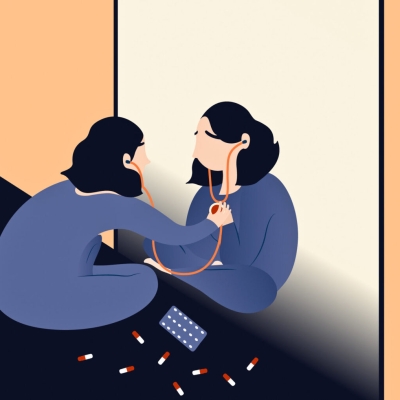
Manipulators. Chaotic. Unstable. Irrational. Hypersensitive. Extreme. Toxic. This is what they call us.
People think we’re unlovable. They’re trying to stay away from us so we don’t destroy them, so we don’t push them out of their comfort zone. Relationships are not for us. They’re for the emotionally stable.
Borderline is a personality disorder.
First of all, you should know that the biggest difference between personality disorders (borderline, narcissistic, antisocial, schizoid, etc.) and mood disorders (such as depression and bipolar,) is that the former manifest in multiple life contexts, often unexpectedly, and affect the quality of life in family, school, career, couple settings, etc., while mood disorders manifest in the face of specific situations, triggers and automatic thoughts. Personality disorders begin to be visible in adolescence; mood disorders can occur at any time in life and manifest periodically. Most of the time, personality disorders can only be diagnosed from the age of 18. These are thought to result in a more chaotic life than mood disorders.
In mood disorders, the effects are triggered by certain external or internal factors and last for a certain period of time (e.g. several days). In Borderline, however, the disorder is always there – the moods it gives, the intense feelings, the uncontrollable actions don’t come and go, but can activate at any time of the day, or even several times an hour. Personality disorders can be felt at any time, the symptoms are always present, and for me, not a day goes by without a borderline episode.
Borderline Personality Disorder (BPD) is a mental condition that affects the way you think and feel about yourself and others, causing problems in the way you function in everyday life. “Borderline is like a seesaw, and the person suffering from this disorder is almost always on both sides of the seesaw. Up and down; right and wrong; yes and no.”
In short, Borderline means constant war!
I didn’t choose this!
This disorder often stems from childhood trauma, disorganised attachment to parents, and the fact that our most fundamental needs were not met when we were children. In addition, we were born with a genetic predisposition to be hypersensitive, with more intense emotionality than ‘normal’ people. Specifically, Borderline means a large dose of invalidation from childhood, which, for many, probably sounded something like this: “But what did I do to you?”, “Stop crying so much, you have nothing, it’ll pass by the time you get married.”, “You wouldn’t die for such a thing!”, “Others have it worse”. All these phrases and many others used by families in Romania affect a child’s psyche, even if we are so used to them that they don’t seem like a big deal. Invalidation is psychological abuse! Yes, abuse.

© Reina Gattuso
What it’s like to live with BPD day to day
Imagine having emotions so intense they physically disable you. Now imagine, on top of that, feeling ashamed, embarrassed, and guilty for having had those emotions in the first place. There’s a constant battle in our heads.
I didn’t want to be born hypersensitive and emotional, I didn’t want to go through all the traumas I went through, I didn’t want to feel all the destructive emotions I felt, I didn’t want to attempt all the suicide attempts I made, I didn’t want to be hurt by all the people who hurt me, and I didn’t want to hurt others in turn. But when it comes to Borderline, my emotions are not in my control! And actions are activated by emotions, so I can’t even control them, except to a very small extent.
I wake up every morning thinking, “What will I get today? Dissociation? Paranoia? Anger? Emotional collapse? Euphoria? Impulsivity? Anxiety? Who knows… But I’ll probably get them all and experience them all within an hour, as usually happens. It depends on how many triggers* life decides to give me today.”
I am an advanced case of BPD, which means my first suicide attempt occurred in my first year of adolescence, and symptoms worsened each year. Up to the age of 25, the disorder continues to progress. Normally, it’s only from the age of 25 that a person with BPD also starts to have episodes of grandiosity along with positive thoughts (finally). Well, I’ve already been through such an episode, and I’m 20 years old.
Since I was a child, I haven’t felt like I belonged anywhere. I never knew who I truly was, I didn’t find my identity in anything, even though I tried many things.
Different names? Checked. Weird hair colours? Checked. Movie characters? Checked. Imaginary friends? Checked. All sorts of religions? Checked. But still, who am I? This is a question that has never left me and has often kept me awake at night. My self-image is always poor. No matter how much I might hate someone who perhaps ruined my life, I hate myself the most. For no rational reason. But that’s what trauma and abuse do, and that’s what Borderline does.
I have a constant feeling of guilt. I have the ability to push someone out of my life without truly wanting to, simply because of actions and emotions I cannot control. I am blinded by a mental fog when dissociation is present. I am in a continuous emotional crisis and never feel safe. I am unable to tolerate my own company. And not to mention psychotic episodes, which, although not frequent in my case, when they happen, everything is so vivid, so real, that the next episode I enter is PTSD (post-traumatic stress disorder) combined with depression, and it lasts about two weeks during which I can’t move much, barely speak, am (slightly) irritable, etc.
Can it get any worse?
Apparently yes, because Borderline comes with impulsivity on a large scale. Severe anger issues, to extremes. When I get angry, it’s not a process, like a flame spreading into a consuming fire. I can be calm, and the next second I can become an explosive bomb. In the case of severe Borderline, the spark doesn’t start the flame, but rather triggers the bomb directly.
That’s why we are stigmatised and called ‘mad’ and ‘eccentric’, because we lash out ‘from nothing’, from things considered trivial, suddenly, without any warning. And then we calm down just as quickly. It’s a constant change of moods. A vicious, toxic, and self-destructive cycle. Living day to day is extremely exhausting.
Steps towards functionality
The only way to cope with Borderline is through psychotherapy and medication in some cases, and in my case, it would take at least 5 years to reach the stage of a functional adult capable of coping with ‘normal’ life, and that’s with 2 sessions a week, if there weren’t other mental health issues I need to work on.
However, if you’re reading this and you have or think you have Borderline, don’t be afraid to seek a psychotherapist. There aren’t many specialists in Borderline in the country, and you might feel discouraged.
It’s not your fault you have a mental disorder, but it’s your responsibility to try and get better. Go for it! Don’t give up, find the right person. I’m grateful to have found someone in Cluj open-minded enough to work with me on other disorders more stigmatised than most. You can do this!

© Trina Dalziel
How to support a person with BPD
Be aware of more sensitive topics and specific Borderline triggers*.
If someone is irritable or speaks less than usual, we will automatically think it’s our fault or that the other person doesn’t care, but most of the time it has nothing to do with us.
Leave no room for interpretation in communication! We interpret all surrounding events. For example, if we miss the bus, we automatically think everything will be a disaster. If our partner says something negative about themselves, we will internalise it and believe we are horrible people. If they don’t talk to us, we feel abandoned.
Learn everything you can about communication in Borderline!
Click here for a reliable source (the website is in English).
Anything that makes us feel rejected, criticised, or abandoned is an automatic trigger that can lead to a Borderline episode full of anger, impulsivity, fear, self-harm, and even suicidal thoughts or attempts.
ATTENTION!
Major holidays can be a powerful trigger for those with Borderline, especially Christmas, due to the atmosphere of happiness, family, gifts, etc. People tell us something is wrong with us if we don’t love Christmas or don’t want to go out in the snow. Yes, something is wrong with us: we were traumatised from a young age by family members and cannot stand the flashbacks that come during the holiday season. Let us be!
Finally, don’t forget that every person, brain, and traumatic experience is different, so you need to make an effort to learn the triggers of your loved ones.
If you’ve been diagnosed with Borderline or identify with this article, this is for you:
“Borderline is like a curtain over the window of the soul. Your soul is dark, cloudy. But it’s not your fault. Never forget what your heart truly yearns for. Never forget who you are, what you are, and how profound you are. You don’t find pleasure in superficiality. You enjoy diving into the depths of life. That’s where you belong, and it’s so beautiful. Don’t let anyone tell you otherwise, not even your disorders.” (by Tough).
Other resources:
The author’s website for destigmatising mental disorders: https://imultidimensional.wordpress.com
Interview in English with a psychiatrist on how to identify the major characteristics of borderline disorder: https://youtu.be/to5qRLRSS7g
Article in English about the difference between a personality disorder and a mood disorder: What’s the Difference Between a Personality Disorder and a Mood Disorder? | Promises Behavioral Health
*Trigger = “declanșator”, an irritating factor that causes automatic emotional reactions. A stimulus that can determine intense negative experiences, thoughts, and states in a person.